Guides
Physical Therapy Cancellation Policy: A Template That Reduces No-Shows
Physical therapy cancellation policy template with variable USD fee wording for US clinics. Pair it with signed patient acknowledgments and payer checks.
What to take away
- A physical therapy cancellation policy template works only when the no-show fee is variable and tied to your state and payer contracts.
- Write the policy around three moving parts: notice window, fee trigger, and documentation trail.
- Check each step with a visible sign-off: front desk notes, patient acknowledgment, and a monthly no-show log.
- The step that decides the result is the PT cancellation fee wording, because weak wording is what patients dispute.
- Stop and hand this to a healthcare attorney or compliance officer if any payer contract conflicts with your state consumer protection law.
Before you draft the policy
A cancellation policy for physical therapy should not look like a hospital billing notice. Before you write a physical therapy cancellation policy template, collect three items.
First, your current intake forms and appointment reminders. Second, the no-show clauses from your top five payer contracts. Third, your state's consumer protection statute on healthcare cancellation fees. A few states restrict fees or require a posted sign. If you cannot find your state rule, ask your state physical therapy board or a local healthcare attorney.
A missed call at the front desk is a common source of no-shows, as the AHRQ communication guidance for office-based care teams describes. If you send policy reminders by text, you must follow the HIPAA Privacy Rule for protected health information.
The sequence to build your policy
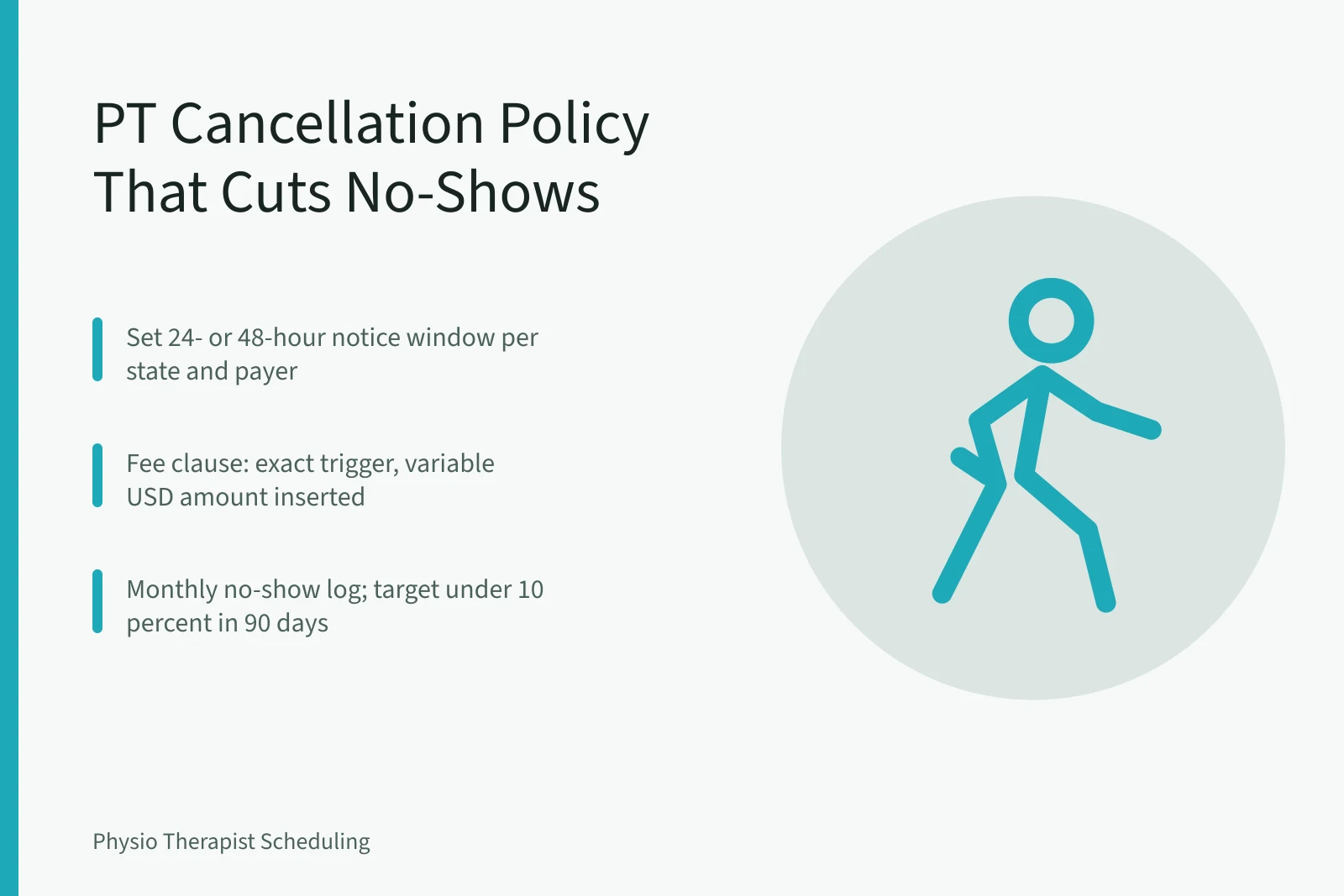
- Set the notice window. Write how many hours before an appointment a patient must cancel or reschedule. Common windows are 24 or 48 hours, but your state or payer contract may set a maximum.
- Define the no-show and late cancellation trigger. A no-show is a missed appointment with no call, email, or portal message before the start time. Late cancellation is any notice inside the window.
- Write the fee clause with a variable. Use this sentence: "If you cancel with less than [insert hours] notice or do not attend, you may be charged a cancellation fee of up to [insert USD amount] unless prohibited by law or your payer contract." Do not name a fixed dollar amount in the policy because Medicaid and some commercial plans forbid certain fees.
- Add the documentation rule. Front desk staff must record the attempt to contact the patient, the time of contact, and who took the call.
- Add the patient acknowledgment line. The patient signs or clicks that they read the policy before the first visit.
For tools that log no-show contacts, see Physical Therapy Scheduling Software.
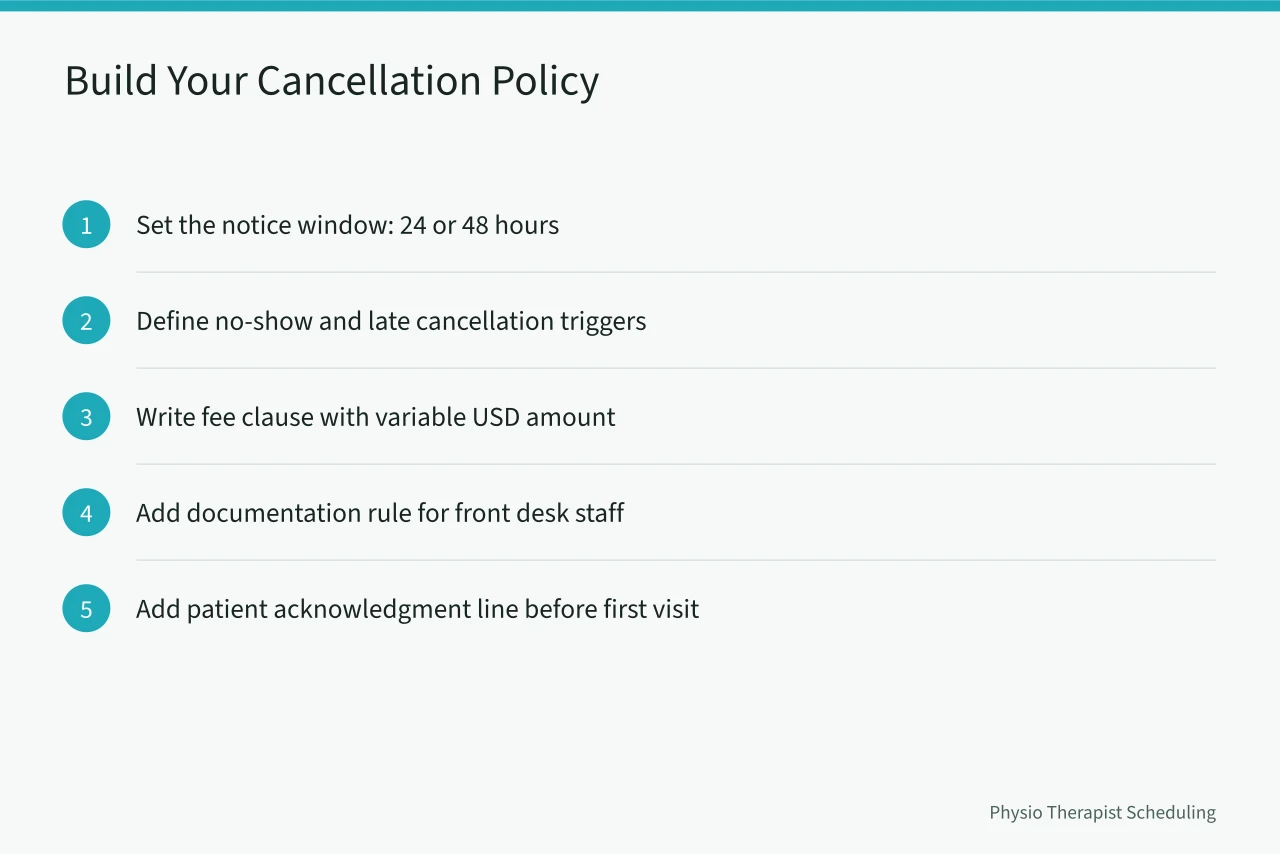
The fee wording step that decides the result
This is the step that determines whether patients understand and accept the charge. Weak wording invites disputes because it sounds optional or punitive. Strong wording states the exact trigger and leaves the USD amount variable.
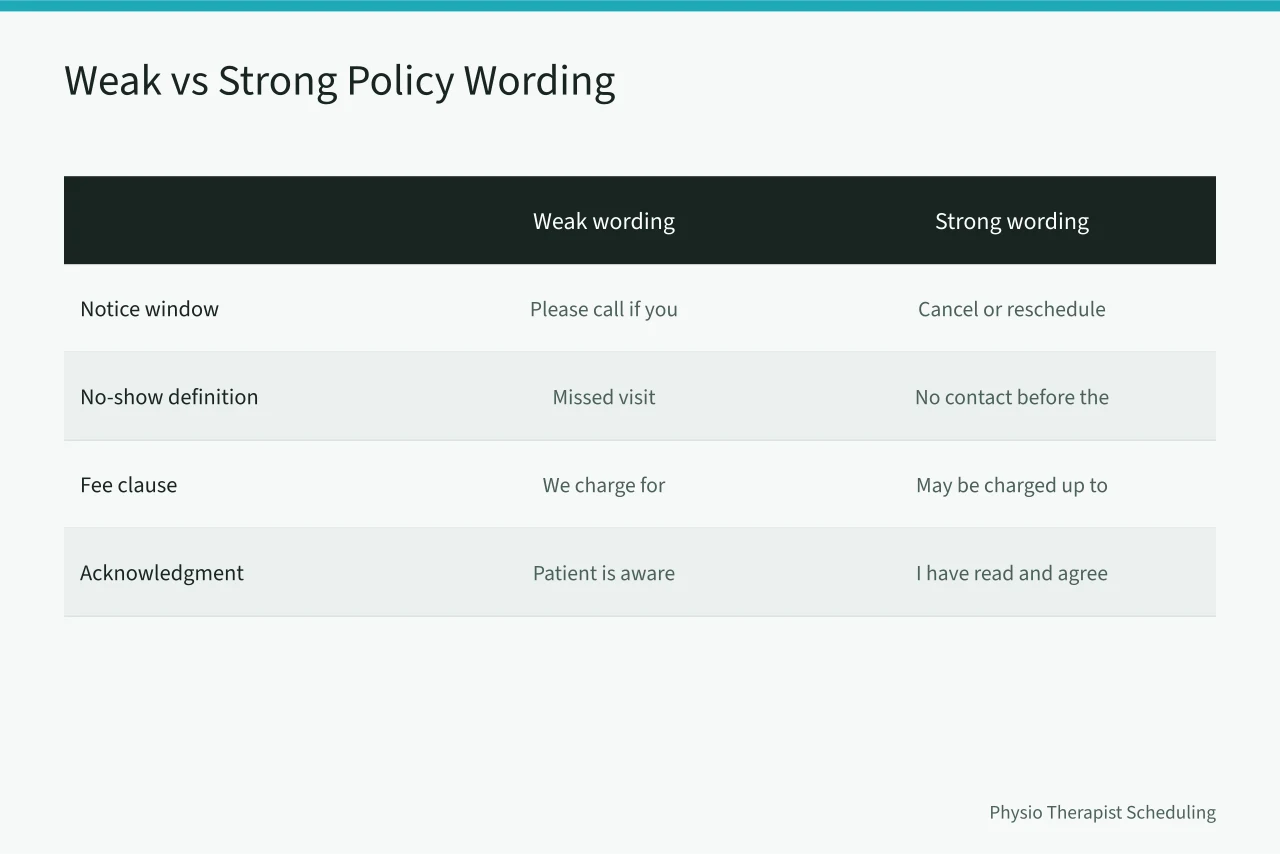
| Policy element | Weak wording | Strong wording |
|---|---|---|
| Notice window | "Please call if you cannot come." | "Cancel or reschedule at least 24 hours before your appointment." |
| No-show definition | "Missed visit." | "No contact before the scheduled start time." |
| Fee clause | "We charge for cancellations." | "You may be charged a cancellation fee up to [insert USD amount] unless your insurance contract or state law says otherwise." |
| Acknowledgment | "Patient is aware." | "I have read and agree to the cancellation policy, including any fee." |
The table is a starting point. Replace the bracketed USD amount with the number your state and payer contracts allow. If any payer contract sets a lower cap, that cap wins in the written policy.
How to check each step came out right
Use a visible sign-off for each step. A monthly no-show log is the simplest measurable check.
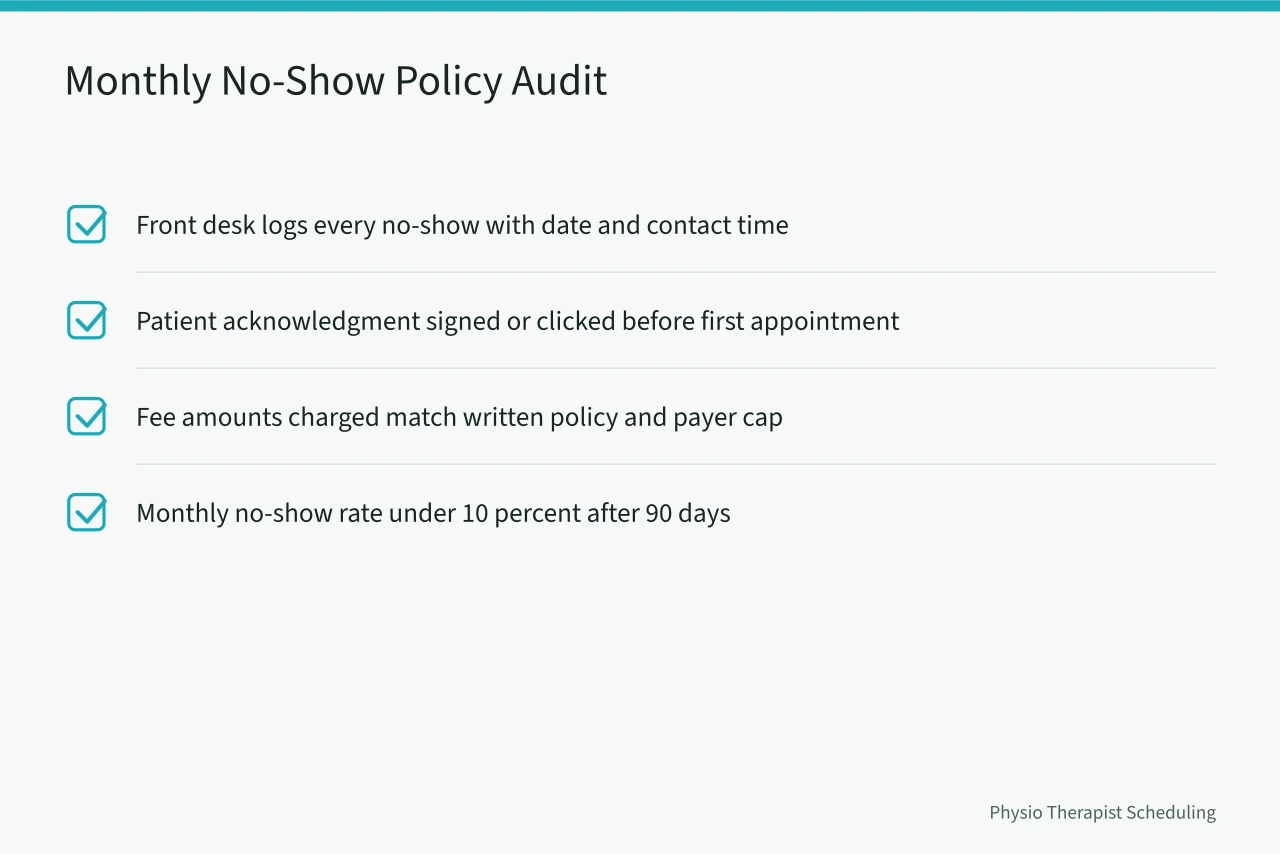
- Front desk logs every no-show with date, patient name, contact time, and method.
- Patient acknowledgment is signed or clicked in the intake form before the first appointment.
- Fee amounts charged match the written policy and any payer contract cap.
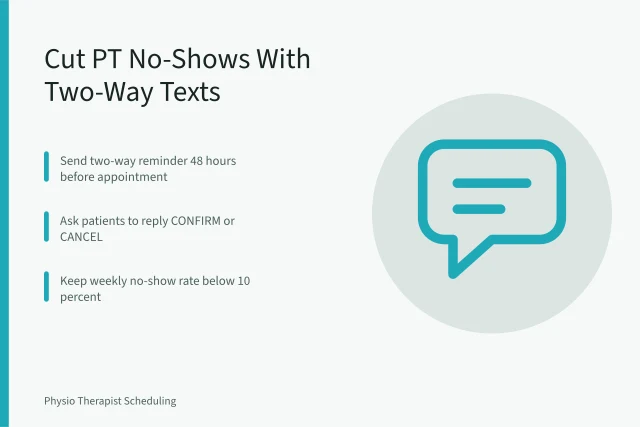
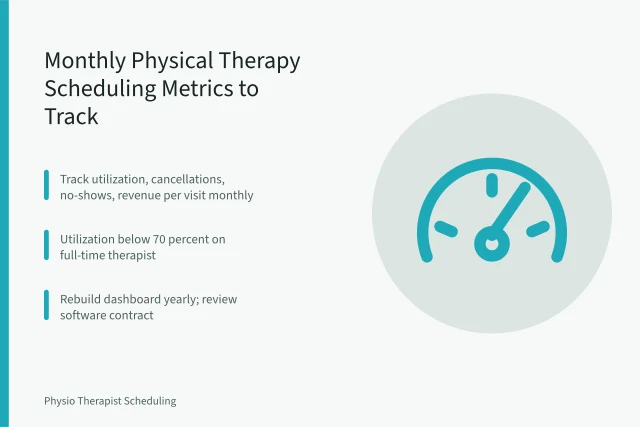
- Monthly no-show rate is under 10 percent after 90 days.
What to do when a step goes wrong
When a patient disputes a fee, do not argue at the front desk. Pull the signed acknowledgment and the contact log first. If either item is missing or the time stamp contradicts the policy, waive the fee for that visit. Then have the front desk lead role-play a no-show call with the staff member who missed the step. If the front desk keeps missing contact logs, review HIPAA-compliant scheduling software that records messages automatically.
When to stop and hand it to a professional
Stop and hire a healthcare attorney or compliance officer when any of these three conditions is true. First, a payer contract prohibits no-show fees but your state law permits them. Second, two patients formally dispute the fee in the same month. Third, your state's attorney general sends an inquiry about the policy.
A professional should also review the final template before you print it if your clinic is in California, New York, or Texas. For state-specific language, see New York physical therapy no-show policies before you finalize.
Common questions
What is a physical therapy no-show policy? A physical therapy no-show policy states how much notice a patient must give to cancel or reschedule, and what fee may apply if they do not.
Can I charge a cancellation fee for a physical therapy appointment? Yes, in most states, if the fee is disclosed in advance and does not violate a payer contract or state consumer protection law.
Does Texas require different PT cancellation fee wording? Texas clinics should review Texas physical therapy scheduling because direct access and Medicare rules can affect the notice window and fee language.
What if a patient refuses to sign the acknowledgment form? Do not schedule the first visit until the acknowledgment is signed. You can still treat the patient later, but the policy is not enforceable without that record.