Guides
What is changing in physical therapy demand for 2027
Physical therapy trends shaping demand: seven forces, where to read each from a primary source rather than a headline, and what a small practice does about it.
What to take away
- No statistic appears here. Each trend below names the primary source where the current reading lives, because a figure on a page is stale by the time it is read and often wrong when it was written.
- Seven forces move demand for a physical therapy practice: payer policy, state rules on access and supervision, telehealth rules, the workforce, the age and activity of the population, employer and self-pay demand, and consolidation.
- A trend matters to a small practice only where it changes the calendar, the fee, the rule or the hire. Each row ends with that.
- Read the source, write the date, decide, and re-read on a calendar. That is the whole method.
Reading a trend before acting
- Find the primary source: the payer's own notice, the state board's own rule, the federal agency's own page. Not a summary of it.
- Write down what it says, in one sentence, with the date you read it.
- Ask which of four things it changes for this practice: the calendar, the fee, a rule, or a hire.
- Decide the smallest change that responds to it, and who owns that change.
- Put the re-read date on the compliance calendar.
The seven forces
| Force | Where to read it | What it changes | What to do on Monday |
|---|---|---|---|
| Payer policy on therapy coverage, authorization and documentation | Each payer's published policy and notices; for Medicare, the CMS therapy services page, which carries the current coding and billing material and its updates | The fee collected per visit, the authorization gate on the calendar, the note | Name the person who reads payer notices; check the billing settings against the current page |
| State rules on referral, supervision and delegation | The state physical therapy board's own publications and any pending rule changes it posts | Who may be seen without a referral; whether an assistant column can run; the role you can hire | Reopen the compliance file, as the licensing and compliance guide describes, whenever the board posts a change |
| Telehealth and remote care rules | The state board, each payer's policy, and federal program guidance | Whether a remote check-in slot exists and is paid | Add or remove the remote slot type in the template; the operations and workflow guide covers slot types |
| The workforce | The Bureau of Labor Statistics page on physical therapists, which carries its current employment outlook and links to state and area pay data | Whether the next column can be filled, and at what loaded cost | Write the role as a calendar, per the hiring and training guide, and set the offer from the BLS data and postings dated today, as pay rates and labor costs explains |
| Age and activity of the population | Public census projections for the area; the practice's own referral log by age and reason | Which service lines fill and which slot types the template needs | Compare the referral log against the lines offered; add a line only against the empty-slot map |
| Employer, team and self-pay demand | The practice's own inquiry log; local employers and programs that have asked | Cash lines, contract blocks, the fee schedule | Log every inquiry by source; the marketing and growth guide covers the four channels |
| Consolidation and larger groups | Public announcements; what referrers say about where their patients are being sent; the SBA business guide for the general options a small business has when a larger competitor arrives | Referrer relationships, labor competition, and whether the practice grows, partners or stays small | Call each referrer this quarter; write the growth trigger down before it is needed |
What the forces have in common
Every row ends on the calendar. A payer change moves the authorization gate; a board change moves the assistant column; a telehealth change adds or removes a slot type; a workforce change decides whether a column can be filled.
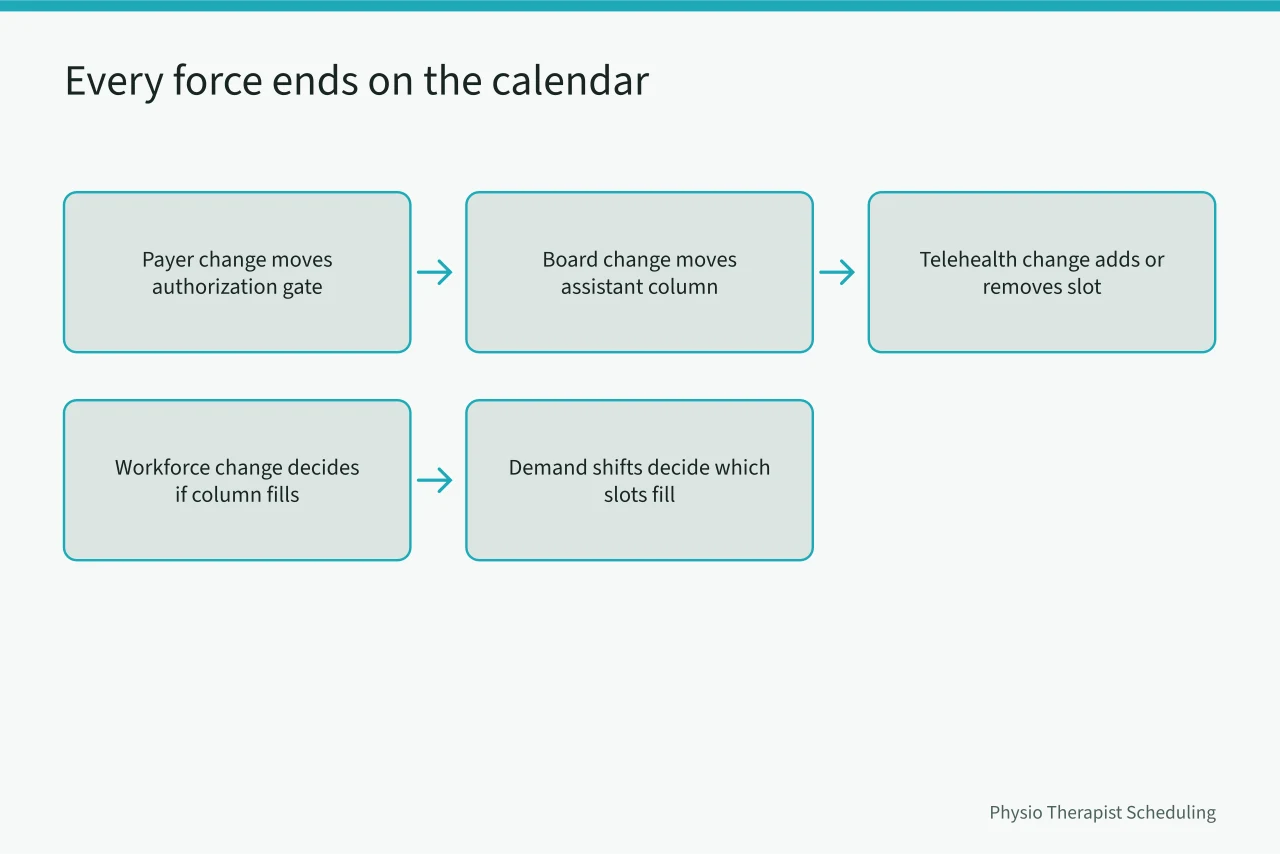
Population and demand shifts decide which slot types fill and which cash lines the front desk offers. Consolidation decides whether referrers keep sending patients to that calendar. A practice that reads the forces through the template, not a headline, knows what to do with each one.
What not to do
Do not restructure the practice around a trend read from a summary. Do not add a service line because a trend says it is growing, without the board's answer and an empty slot to put it in.
Do not set fees or pay from a trend article's figure; this site states none, and the primary sources are dated for a reason. And do not stop reading the payer notices because the year was quiet; the change that matters arrives in the one you skipped.
Common questions
Which trend matters most for a small practice?
Payer policy, because it changes the fee collected per visit and the gate on the calendar without any action by the practice, and it changes on the payer's schedule. The person who reads payer notices is the practice's most important trend analyst.
Is demand for physical therapy growing?
The Bureau of Labor Statistics publishes its current employment outlook for the profession, and that is where to read the direction for the year you are in. What matters to one practice is the referral log and the waitlist, which are its own demand and the only ones it can act on.
Should a small practice worry about larger groups?
Watch what referrers say about where patients are sent and what postings the groups run for staff. Then keep the referral-to-evaluation days short and the report-backs on time, because those are what a referrer compares.