
Guides
Physical therapy cash flow basics for owners who hate spreadsheets
Physical therapy bookkeeping and cash flow basics: the ledger lines a clinic needs, the visit-to-deposit lag, a weekly routine, and a thirteen-week cash view.
What to take away
- A practice's books have three lines most businesses do not: contractual adjustments, patient share receivable, and prepaid package liability. Without them the revenue figure is fiction.
- Cash arrives weeks after the visit for insured patients. Bookkeeping that records revenue when billed and ignores the lag is how a full calendar runs out of money.
- Every week: reconcile the schedule to the claims and the claims to the deposits. Every month: close with the adjustments and the write-offs separated.
- The thirteen-week cash view, kept in named variables and updated weekly, is the single document that prevents surprises.
The ledger lines a clinic needs
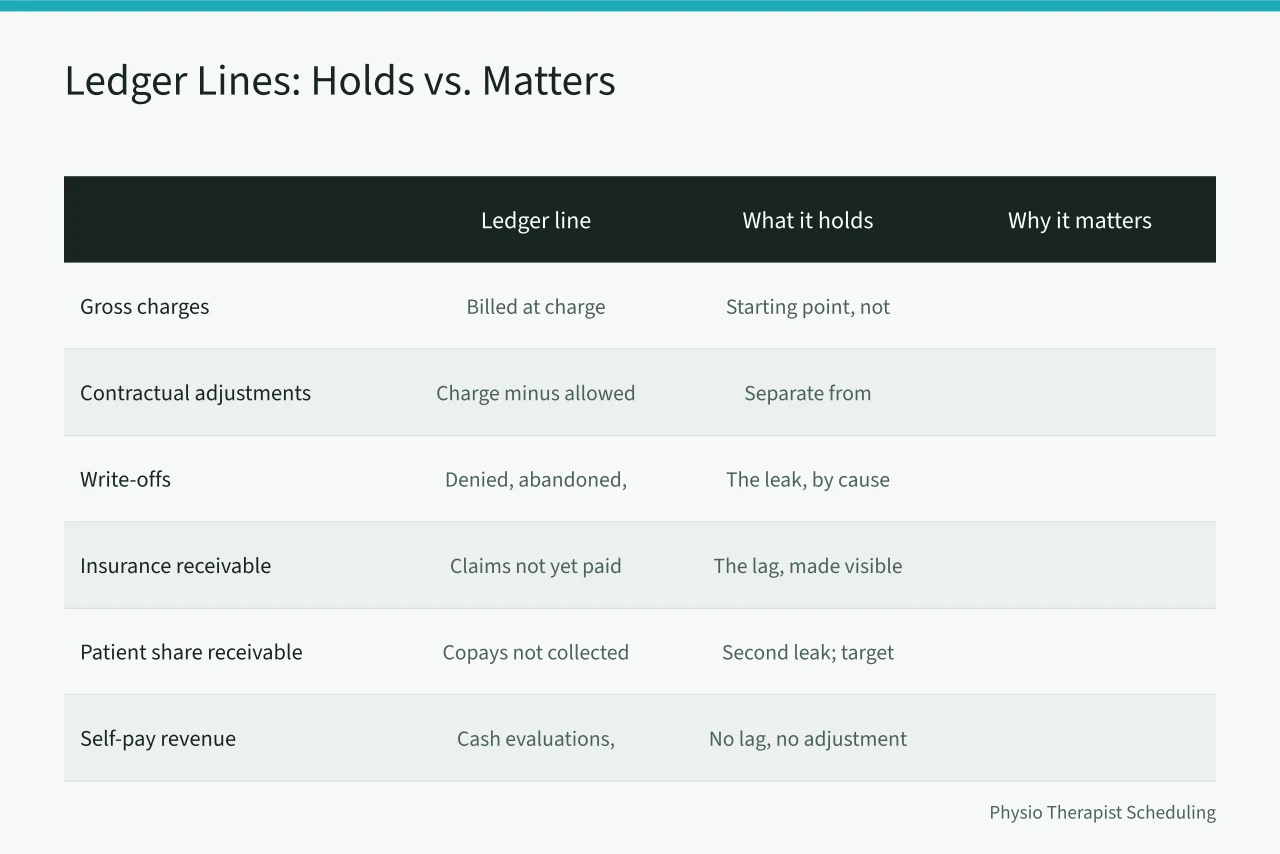
| Line | What it holds | Why it matters |
|---|---|---|
| Gross charges by payer and visit type | What was billed at the practice's charge for each delivered visit | The starting point, not the revenue |
| Contractual adjustments by payer | The difference between the charge and the payer's allowed amount | Expected and unavoidable; separate from write-offs or the books hide bad debt |
| Write-offs by reason | Denied and abandoned claims, uncollectable patient share, policy waivers | The leak, by cause |
| Insurance receivable by payer, aged | Claims submitted and not yet paid | The lag, made visible |
| Patient share receivable, aged | Copays and balances not collected at the visit | The second leak; the target is near zero because the share is collected at check-in |
| Self-pay revenue by line | Cash evaluations, treatment, programs | The only revenue with no lag and no adjustment |
| Prepaid package liability | Money received for sessions not yet delivered | A liability until delivered, reduced per session from the session log |
| Operating expenses by category | Rent, payroll, software, supplies, insurance, professional fees | The fixed and variable cost the pricing arithmetic relies on |
An accountant who works with medical practices sets this up in a week. One who does not will book gross charges as revenue, and the practice will believe it is doing better than it is.
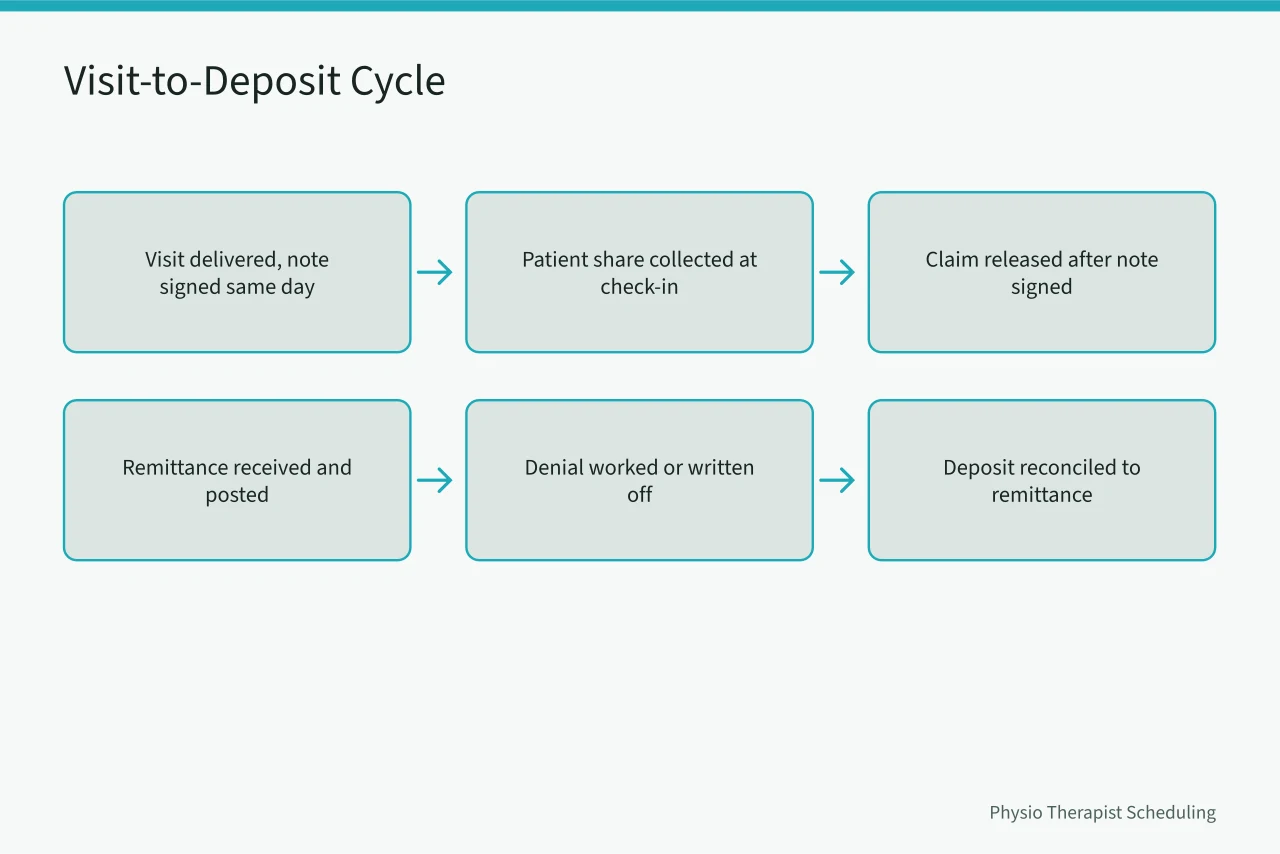
The visit-to-deposit cycle
- Visit delivered and note signed the same day.
- Patient share collected at check-in and posted the same day.
- Claim released only after the note is signed, and submitted on the practice's stated cycle.
- Remittance received from the payer after the payer's own interval, posted with the contractual adjustment and any denial recorded by reason.
- Denial worked within a stated number of days, or written off with a reason.
- Deposit reconciled to the remittance and to the claim.
The lag is steps three to four, and it differs by payer. Measure it per payer from the remittance dates and keep the figure current, because it is the L in the cash view below.
The weekly routine
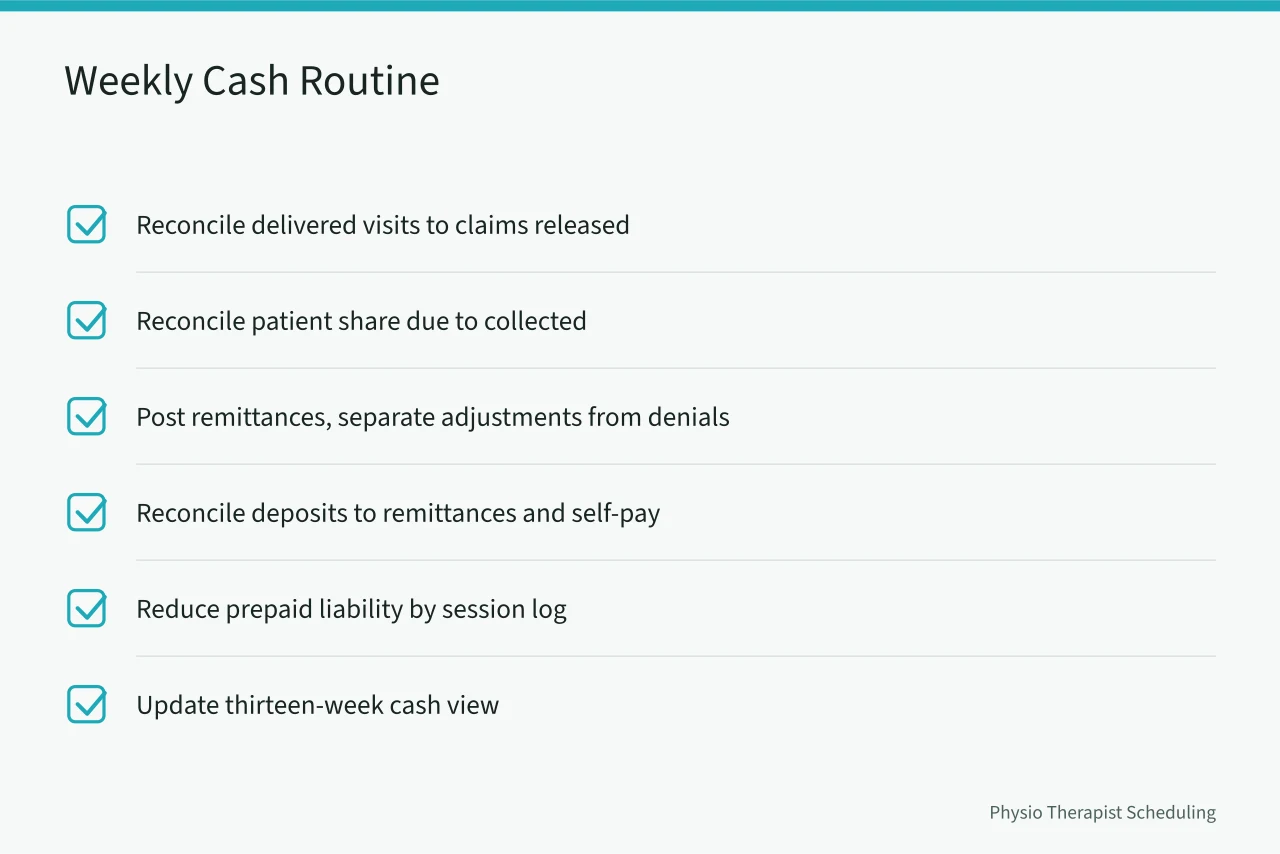
- Delivered visits from the schedule reconciled to claims released; any delivered visit with no claim, or claim with no delivered visit, explained.
- Patient share due reconciled to patient share collected; the difference becomes the patient receivable, and the front desk lead sees the list.
- Remittances posted, adjustments separated from denials, denials assigned by reason.
- Deposits reconciled to remittances and to self-pay receipts.
- Prepaid package liability reduced by the week's session log.
- The thirteen-week cash view updated.
The routine takes an hour once the ledger is set up correctly. The software and KPI guide covers why the schedule, billing and accounting systems have to reconcile without retyping for that to be true.
The thirteen-week cash view
A worked example in variables
For each of the next thirteen weeks:
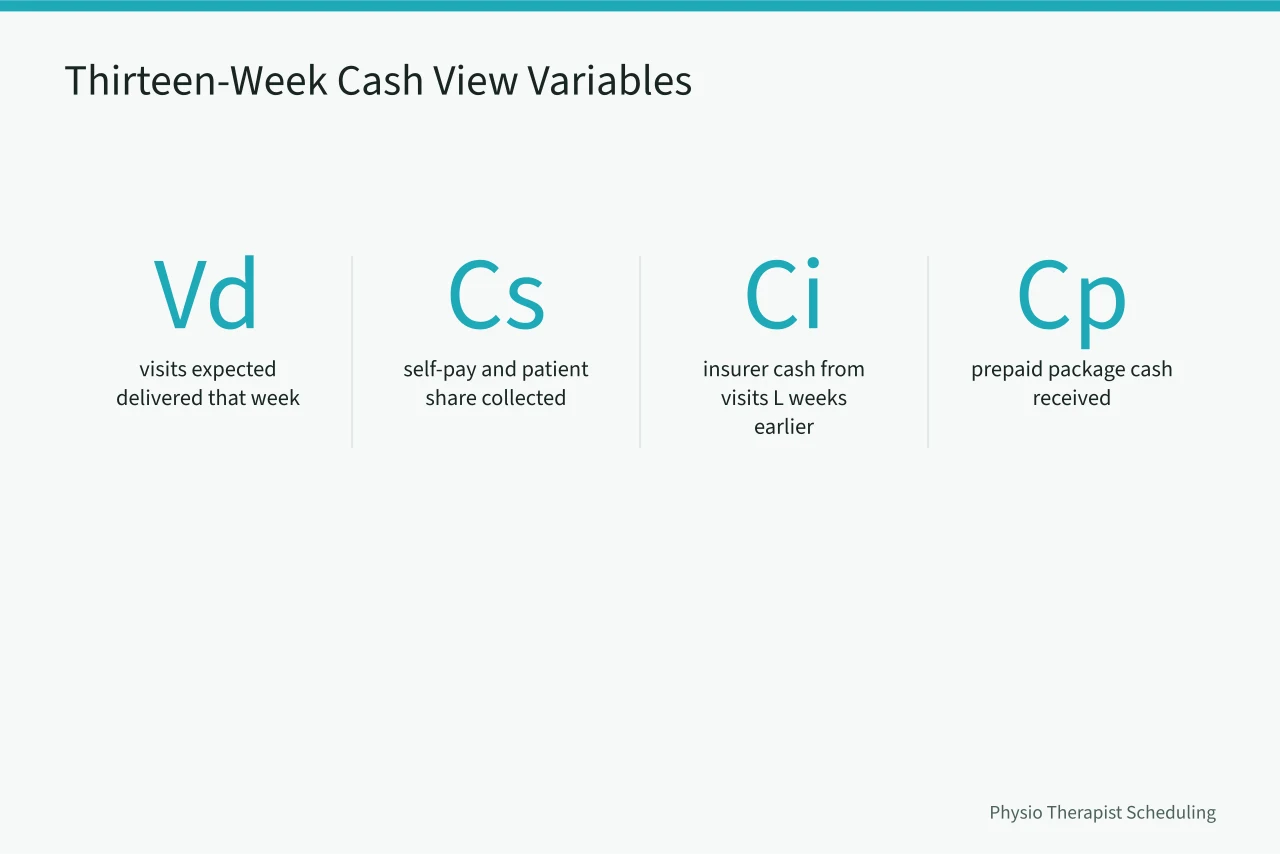
- Vd: visits expected to be delivered that week, from the schedule and the cancellation rate.
- Cs: cash collected that week from self-pay visits and patient share, roughly Vd for those visits times what each collects.
- Ci: cash arriving that week from insurers, which is the insured visits delivered L weeks earlier times the collected-per-visit for those payers, where L is each payer's measured lag.
- Cp: cash received that week for prepaid packages, which is cash now and revenue later.
- F: fixed cash out that week: rent, payroll on its dates, loan payments, subscriptions.
- V: variable cash out that week: supplies, card fees, per-claim billing cost.
- Opening balance B0 for week one, from the bank.
Closing balance each week: B = opening balance + Cs + Ci + Cp minus F minus V, and next week's opening balance is this week's closing balance.
The view shows the low point and the week it falls in. Because Ci depends on visits delivered L weeks ago, a slow month shows up in the cash view L weeks after the schedule, and the view warns you.
Payroll dates and the month's rent produce the dips. A line of credit sized to the lowest B is the usual cover, and you make it before the dip, not during it.
Security of the books
Accounting and billing data pair patient names with amounts, so they are health information and financial records.
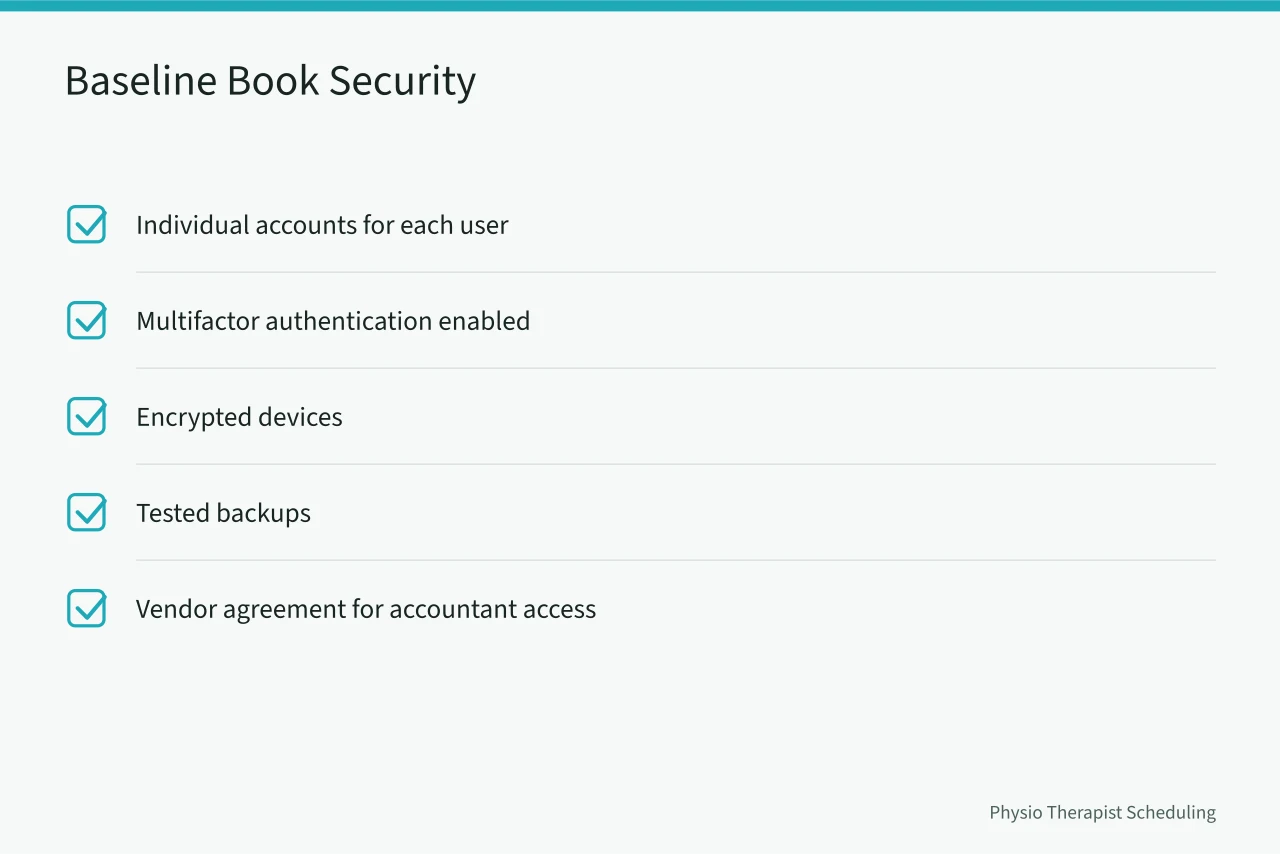
The NIST small business quick-start guides and CISA guidance for small and medium businesses set out the baseline for a small organization: individual accounts, multifactor authentication, encrypted devices, tested backups. The compliance adviser says what the privacy rules require on top.
An accountant's or bookkeeper's access to the records is covered by a vendor agreement like any other.
The tax record
The IRS guidance on which records to keep expects a business to show its income and what produced it, and to keep the documents behind purchases, payroll and assets. For a clinic, the schedule, the claims, the remittances and the deposits are the income trail, and the weekly reconciliation keeps it unbroken.
Which entity form the practice uses, and what that means for its filings, is a question for the accountant. It is part of the compliance file the licensing and compliance guide describes.
Who does what
The front desk posts patient share and the session log daily. The biller posts remittances and works denials.
The owner or a bookkeeper runs the weekly reconciliation and cash view. The accountant closes the month and files.
The hiring and training guide puts daily posting into the front desk's first week. The marketing and growth guide explains why new evaluations by source is the number that feeds Vd thirteen weeks out.
Common questions
Should revenue be recorded when billed or when collected?
Ask the accountant which basis the practice uses for its books and its tax filings; both exist and each has consequences. Whichever it is, the cash view is kept on cash, because the bank balance is what pays payroll.
How much should be in reserve?
Enough to cover the lowest closing balance in the thirteen-week view with a margin the owner chooses. No figure from a page can replace the view built from your own lags and payroll dates.
Why separate contractual adjustments from write-offs?
Because one is expected and the other is a loss with a cause. A ledger that merges them cannot tell the owner whether collections are failing or whether the charge master is simply higher than the allowed amounts.
Can the front desk do the bookkeeping?
The front desk posts what it collects and the session log. Reconciliation and the month-end close need someone who is not also answering the phone, and the accountant reviews the result.